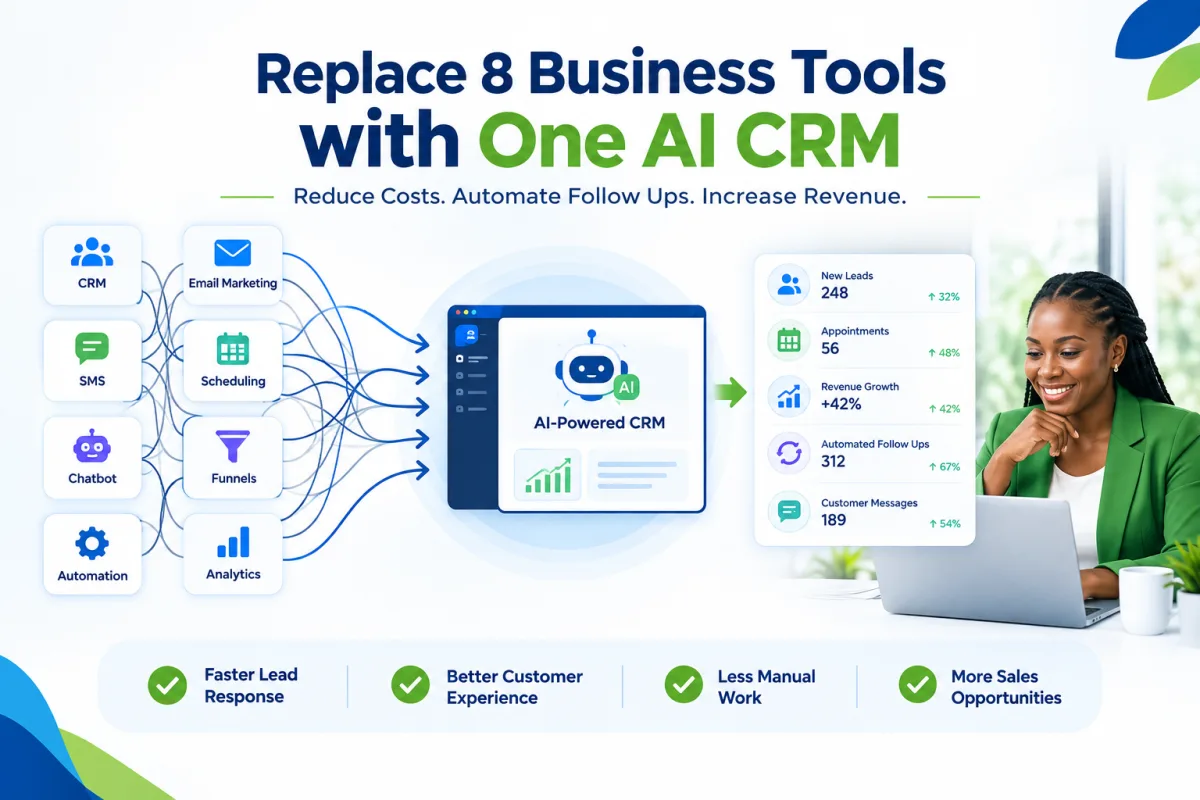
Many service businesses in the United States are drowning in software subscriptions.
A typical home service company, marketing agency, consulting firm, cleaning business, HVAC contractor, law firm, or healthcare practice often uses separate tools for customer management, email marketing, appointment scheduling, texting, invoicing, automation, customer support, and reporting.
While each tool serves a purpose, managing multiple platforms creates a new problem: complexity.
Teams waste time switching between systems, customer data becomes fragmented, and monthly software costs continue to rise. Even worse, leads can fall through the cracks when integrations fail or follow-up processes break down.
This is why many service businesses are moving toward AI-powered CRM platforms that combine multiple business functions into one centralized system.
The Hidden Cost of Using Too Many Business Tools
Most service businesses don't intentionally build a complicated software stack. It happens gradually.
A business starts with a CRM.
Then adds:
- Email marketing software
- Appointment scheduling software
- SMS marketing tools
- Landing page builders
- Chatbots
- Automation platforms
- Call tracking software
- Analytics tools
Before long, business owners are paying for eight or more tools every month while spending valuable time managing integrations and troubleshooting issues.
The result includes:
- Higher software expenses
- Duplicate customer records
- Inconsistent reporting
- Slower response times
- Missed sales opportunities
- Reduced team productivity
The 8 Tools an AI CRM Can Replace
Modern AI CRM platforms are designed to centralize customer management, communication, automation, and marketing.
Instead of using separate platforms, businesses can often replace:
1. Traditional CRM Software
Customer information, communication history, sales pipelines, and customer interactions are stored in one location.
2. Email Marketing Platforms
Businesses can create automated email campaigns, newsletters, and lead nurturing sequences directly inside the CRM.
3. Appointment Scheduling Tools
Customers can book appointments online while the CRM automatically updates calendars, sends reminders, and tracks activity.
4. SMS Marketing Platforms
Text messaging campaigns, appointment reminders, and customer follow ups can be managed from the same platform.
5. Landing Page and Funnel Builders
Many AI CRMs include tools for creating lead capture forms, landing pages, and sales funnels.
6. Chatbots and Customer Messaging Tools
AI-powered assistants can answer common questions, qualify leads, and engage website visitors 24 hours a day.
7. Workflow Automation Software
Automated workflows eliminate repetitive tasks such as follow-ups, reminders, lead routing, and status updates.
8. Reporting and Analytics Platforms
Business owners can monitor sales, customer activity, marketing performance, and team productivity from one dashboard.
How AI Makes the Difference
The biggest advantage isn't simply consolidating tools.
It is the addition of artificial intelligence.
Traditional CRM systems often act as databases that require manual updates. AI-powered CRM platforms actively help businesses automate and optimize customer interactions.
AI can:
- Respond to enquiries instantly
- Qualify leads automatically
- Schedule appointments
- Generate follow-up messages
- Analyze customer behavior
- Recommend next actions
- Predict sales opportunities
Instead of simply storing customer information, AI helps businesses take action faster and more consistently.
Example: A US Home Service Business
Imagine a plumbing company operating in Texas.
Before adopting an AI CRM, the business uses:
- HubSpot for customer management
- Mailchimp for email marketing
- Calendly for bookings
- Twilio for SMS
- Zapier for integrations
- Call tracking software
- Chatbot software
- Google Sheets for reporting
The company spends hundreds of dollars monthly on software subscriptions while employees manually update customer records.
After moving to an AI CRM, customer communication, scheduling, marketing, automation, and reporting operate from a single platform.
The benefits include:
- Faster lead response times
- Improved customer experience
- Fewer missed appointments
- Better follow-up consistency
- Reduced software costs
- Increased operational efficiency
This trend is becoming increasingly common among US service businesses seeking to simplify operations and improve profitability.
Benefits Beyond Cost Savings
Reducing software expenses is only one benefit.
The bigger advantage comes from improving business performance.
Faster Lead Response
Studies consistently show that faster responses increase conversion rates. AI-powered systems can engage leads immediately rather than waiting for staff availability.
Better Customer Experience
Customers receive faster answers, timely reminders, and more personalized communication.
Increased Team Productivity
Employees spend less time entering data and switching between platforms.
Improved Sales Conversion
Automated follow-ups ensure leads remain engaged throughout the buying journey.
Centralized Customer Data
Every interaction is stored in one location, providing a complete view of each customer relationship.
What to Look for in an AI CRM
Not all AI CRM platforms are created equally.
Service businesses should prioritize solutions that offer:
- Contact management
- Automated workflows
- Email marketing
- SMS communication
- Appointment scheduling
- AI-powered follow-ups
- Mobile access
- Customer service tools
- Analytics and reporting
- Integration capabilities
A successful platform should reduce complexity rather than create it.
Common Mistakes to Avoid
When implementing an AI CRM, businesses should avoid:
- Migrating poor-quality customer data
- Automating every customer interaction
- Ignoring employee training
- Choosing software based solely on price
- Failing to map customer journeys before automation
The goal is to improve customer relationships, not remove the human element entirely.
Conclusion
Service businesses across the United States are increasingly replacing multiple software subscriptions with AI-powered CRM platforms that centralize operations, improve efficiency, and drive revenue growth.
By combining customer management, marketing, communication, scheduling, and automation into a single platform, businesses can reduce complexity while delivering a better customer experience.
The real value of an AI CRM is not simply replacing eight tools with one.
It is creating a smarter, more connected business that can respond faster, operate more efficiently, and scale without adding unnecessary complexity.
Many service businesses use separate tools for CRM, email marketing, appointment scheduling, SMS, automation, reporting, and customer communication. While these tools solve individual problems, they often create inefficiencies, higher costs, and disconnected customer experiences. This guide explores how AI-powered CRM platforms help service businesses replace up to eight tools with one centralized system, streamline operations, automate follow-ups, improve customer experience, and increase revenue.